Napoleon's depression after Zach's death
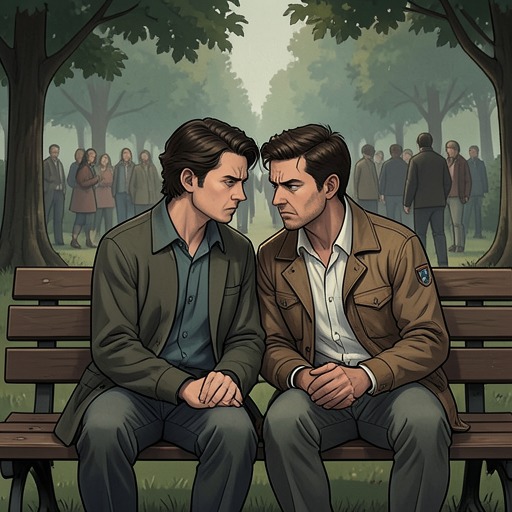
Nine Perfect StrangersNapoleon's depression after Zach's death is a prolonged, physically oppressive grief that changes Napoleon’s understanding of his son’s suicide and continues well beyond the family’s stay at Tranquillum House. Its significance lies in the movement from counterfactual guilt—Napoleon’s conviction that he might have saved Zach—to an effort to imagine what Zach himself experienced, followed by Napoleon’s eventual decision to seek professional help for his own depression.
Identity and Background
Napoleon is a teacher, husband, father, and leader of a support group for parents who have lost children to suicide. He has researched suicide and speaks to newly bereaved parents about evidence that suicidal crises can be brief and that many attempts follow only hours of suicidal thoughts. He also knows that some people survive an attempt and later live happily, and that removing access to a chosen means can allow suicidal thoughts to pass. Yet he withholds these findings from the parents, fearing that they would hear them as proof that their children’s deaths depended on a chance interruption that never came. His informed account of suicide therefore coexists with a painful limit: knowing the research does not give him a way to explain Zach’s death or absolve himself of responsibility.
The Marconi family comes to Tranquillum House because January—the time of year associated with Zach’s death—makes being at home unbearable. When Zoe describes the reason for their visit, Napoleon hears his daughter speak openly about her twin brother’s suicide and their decision to stop telling people how he died because of suicide contagion. Zoe also resists the assumption that twins must have been close: she says that she and Zach attended different schools and had different interests and values. This family context gives Napoleon’s grief a double pressure. He is trying to understand his dead son while his surviving daughter is publicly defining what their relationship was, rather than allowing other people to impose a comforting story on it.
Depression and the Experience of the Retreat
During a night at Tranquillum House, Napoleon feels his heart beating rapidly and welcomes the fear because it briefly interrupts a much more pervasive blankness. He describes the morning’s depression as a fog spreading through his brain, heart, and body, making even speaking, lifting his head, or walking an effort. He tries to act normally and persuade himself that the state may be temporary, like a hangover, and that he may wake the following day feeling like himself again. The contrast between his racing heart and the grey heaviness matters: fear is unpleasant, but it is at least a sensation, a momentary reprieve from numbness.
The depression also disrupts Napoleon’s former confidence in his own temperament. Before the previous night, he would have counted Frances as someone with a similar basic optimism; now he feels that his hope has drained away, leaving him empty and spent. He wonders whether he is angry, but cannot make anger account for what has taken hold of him. The feeling is instead a dull nothingness with the weight and texture of wet cement. That image joins emotional absence to physical burden: he is not simply sad in a way he can readily name, but struggling to move through a world that seems to have acquired mass.
His mind turns repeatedly to what he could, would, or should have done to save Zach. Napoleon remembers the safety conversations he had with his children: do not share personal information online, do not get into a car with a drunk driver, call at any hour, talk about feelings or bullying, and trust that the parents could fix things. The care invested in these promises now sharpens his sense of failure. He had tried to prepare for danger and had assured his children that problems could be solved, yet Zach died by suicide. The recollection does not establish what Napoleon could actually have changed; it shows how bereavement turns parental care into a catalogue of promises measured against an irreversible outcome.
Guilt, Causation, and Zach’s Experience
In the darkness, while Carmel sings and Lars lowers his voice so that she can take over the song, Napoleon has a shift in perspective: perhaps this is how Zach felt. The thought does not resolve the cause of the suicide. Instead, it gives Napoleon’s own depression a painful interpretive use, letting him imagine a state that he previously could only investigate or discuss from the outside.
He cannot determine whether Zach’s asthma medication caused the depression and suicidal thoughts, whether teenage hormones were involved, or whether the factors combined. Heather’s later confession intensifies the family’s uncertainty: the asthma medication could have depression and suicidal thoughts as side effects, and when Napoleon asked whether there were side effects, Heather says she told him no. Napoleon repeats that she said no. The disclosure gives the parents a concrete fact to return to, but not proof that the medication caused Zach’s death. The narrative keeps the distinction between a possible contributing factor and a known explanation unresolved.
Zoe’s account of suicide contagion and Napoleon’s work with bereaved parents also place private grief beside the consequences of public speech. The family stopped describing the method because they feared contagion, while Napoleon’s support-group conversations leave him weighing what bereaved parents can bear to know about impulsive crises and interrupted attempts. These scenes do not offer a simple formula for preventing suicide. They show how survivors search for language that might help others without turning uncertainty into blame, and how the wish to find a preventable moment can become another form of grief.
After Tranquillum House and Seeking Help
Six weeks after returning from Tranquillum House, Napoleon is waiting for an appointment with a psychiatrist referred by his general practitioner. He has waited six weeks for the first available appointment, a delay that makes him think of the mental-health crisis as a practical failure of access, not an abstract concern. In the meantime, he has continued the ordinary tasks of teaching, cooking, talking with Heather and Zoe, and running his support group. From the outside, these routines make him appear unchanged; inside, he experiences his senses as muted, the sky as drained of colour, and daily existence as an exhausting effort. He sleeps whenever he can, and getting up feels like moving his limbs through thick mud. When Heather asks whether everything is okay, he says that it is all good, concealing the extent of his struggle even at home.
At the psychiatrist’s office, Napoleon does not wait for small talk. He tells her about Zach, the drugs he was given at Tranquillum House, and his belief that he has struggled with depression since then. He says his general practitioner offered antidepressants and acknowledges that he may need them, while explaining his concern that dosage is difficult to get right and that some patients can initially feel worse or experience suicidal thoughts. He has researched the drugs, knows their brand names and side effects, and has even prepared a spreadsheet. His knowledge gives him detailed language for treatment risks, but does not settle what is happening to him or what caused it.
Napoleon is careful not to claim that the retreat’s drugs definitively caused his depression. He says the people at the health resort may have meant well and that the depression might have happened anyway. At the same time, he believes he may have been the one person in the room who should never have been given the smoothie. His admission connects the retreat’s intervention to his present fear without converting suspicion into certainty. He is not only asking for care; he is trying to explain why he distrusts the possibility that an unregulated experience may have affected a person already vulnerable to depression.
Napoleon finally tells the psychiatrist that he is terrified he will reach an unnamed outcome, but exhaustion overtakes his attempt to say more. She does not force him to complete the sentence. Instead, she reaches across the coffee table, tells him they are a team, and proposes that they develop a strategy and work to beat the depression. The exchange marks a change in how Napoleon carries the problem: he has moved from pretending to be fine and privately assembling research to telling a clinician what he fears. The ending offers a beginning of collaborative treatment, not evidence that the depression has already lifted.
Narrative Significance
Napoleon’s depression is narrated through the gap between visible function and inner incapacity. He continues to teach, cook, speak with his family, and lead a support group, yet ordinary movement feels like mud and the world loses its colour. That contrast makes his persistence neither proof of recovery nor a simple display of resilience; it shows how distress can remain concealed inside the routines other people take as evidence that someone is unchanged.
The experience also complicates the story’s search for causes. Napoleon’s research, his memories of parental warnings, Heather’s disclosure about the asthma medication, and his suspicion about the Tranquillum House smoothie all offer possible lines of explanation, but none establishes a single cause for Zach’s suicide or Napoleon’s later depression. The firmest change is in Napoleon’s relation to uncertainty: at the retreat, he begins to imagine Zach’s fog from within; six weeks later, he brings his fears and questions to a psychiatrist. The therapist’s promise of teamwork provides a modest counterweight to the solitary work of counterfactual guilt, while leaving the loss itself unresolved.